Personal Identification
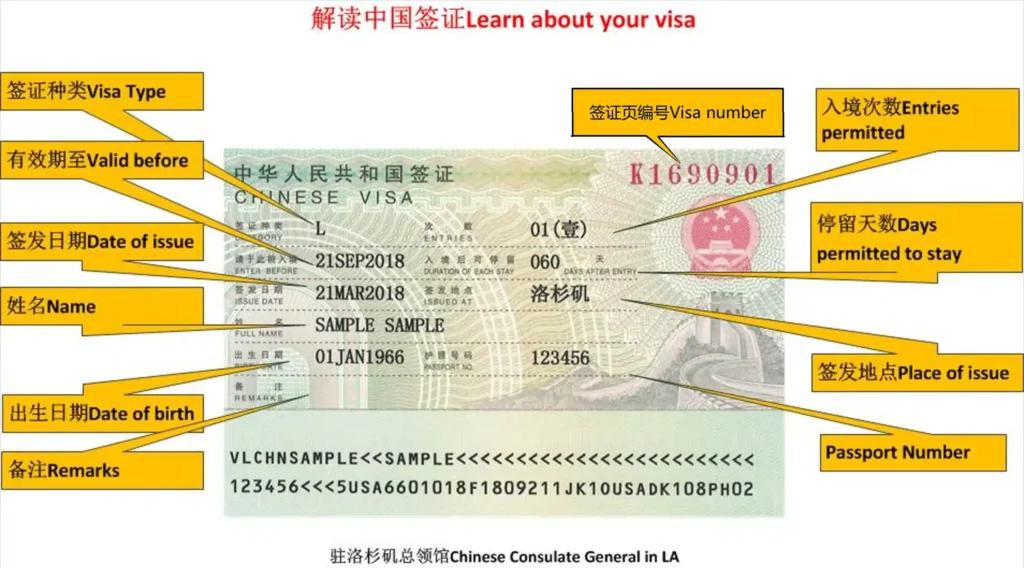
This section must match your passport information exactly; even a single incorrect letter or digit could result in being denied boarding or refused entry.
1. Surname & Given Names:
- Interpretation: Must match the Machine Readable Zone (MRZ) of your passport exactly.
- Note: The Chinese visa system is sensitive to spaces and hyphens. If your name appears as “MARY JANE” in your passport, it shouldn’t appear as “MARYJANE” on your visa.
2. Passport Number:
- Explanation: A visa is linked to a specific passport.
- Important Warning: If you obtain a new passport after receiving your visa (e.g., because your old passport has expired), that visa immediately becomes invalid! You cannot use a valid visa contained in an old passport in conjunction with a new passport (except specific long-term business or talent visas that bear an official endorsement; however, this is strictly not permitted for standard tourist visas). You must apply for a new visa.
3. Date of Birth: Used for identity verification.
4. Nationality: Indicates your citizenship.
5. Gender: Chinese visas typically explicitly mark this as M (Male) or F (Female).
Validity and Stay Duration
This is the area where errors are most likely to occur; please be sure to carefully distinguish between these three concepts.
A. Enter Before / Validity Period
1. Original Correspondence: “From” and “Until”
2. Chinese Visa Terminology: Enter Before (YYYY-MM-DD)
3. In-Depth Explanation:
- This represents the validity lifecycle of the visa. You must arrive at Chinese Customs on or before this specified date.
- Common Misconception: This is not the date until which you are permitted to stay in China. It is strictly the deadline for your entry.
- Example: If the “Enter Before” date is 2026-06-30, you must enter the country before 24:00 on June 30th. If you arrive on the morning of July 1st, the visa is no longer valid.
B. Duration of Each Stay
1. Original Term: “Duration of Stay.”
2. Chinese Visa Terminology: Duration of Each Stay: XX Days
3. In-depth Explanation:
- This refers to the maximum number of days you are permitted to reside within China following each entry.
- Calculation Start Point: The count begins on the day after you enter China (the actual day of entry is counted as Day 0).
- Key Rule: Even if your visa remains valid for another six months, if your “Duration of Each Stay” is set at 30 days, you must depart China within 30 days of your entry. Failure to do so constitutes an “Overstay” (illegal residence), subjecting you to penalties ranging from fines and detention to deportation.
- Extensions: If you require an extension, you must apply to the Entry-Exit Administration Department of the local Public Security Bureau before your authorized stay period expires; extensions cannot be processed on an ad-hoc basis at the airport.
C. Entries
1. Original Term: “Number of Entries”
2. Chinese Visa Terminology: Entries: 00, 01, 02, or M
3. Detailed Explanation:
- 00(Zero): Invalid Visa (typically indicates cancellation or a printing error).
- 01(Single): Single Entry. Once you leave mainland China (even if only for a one-day trip to Hong Kong or Macau), the visa becomes immediately invalid, and you cannot re-enter.
- 02(Double): Double Entry. Suitable for itineraries such as “Mainland China → Neighboring Country → Return to Mainland China.” The visa becomes invalid once both entries have been utilized.
- M (Multiple): Multiple Entry. Allows for an unlimited number of entries and exits within the validity period of the visa.
- Special Note Regarding Hong Kong and Macau: Traveling to the Hong Kong or Macau Special Administrative Regions is considered “leaving mainland China.” If you hold a single-entry visa (01) and travel to Hong Kong, you will need to apply for a new visa to return to the mainland (unless you qualify for the 144-hour transit visa exemption policy).
Visa Specifics
A. Category (Visa Type)
1. Original Term: “Visa Type.”
2. Chinese Visa Terminology: Designated by a single capital English letter.
3. Explanation of Common Codes:
- L (Tourist): Tourism. The most common type requires submission of an itinerary or an invitation letter.
- M (Business/Trade): Commercial/Trade activities. Requires an invitation letter issued by a Chinese business partner.
- Z (Work): Employment. Must hold a “Notice of Work Permit for Foreigners”; upon entry, this must be exchanged for a Residence Permit.
- X1 / X2 (Student): Study. X1 is for long-term study (>180 days) and requires conversion to a Residence Permit upon entry; X2 is for short-term study.
- Q1 / Q2 (Family Reunion): Visiting Relatives. Q1 is for long-term visits (requires conversion to a Residence Permit); Q2 is for short-term visits.
- S1 / S2 (Private Affairs): Private matters (e.g., visiting family members of foreigners working in China).
- C (Crew): Crew members.
- G (Transit): Transit.
- D (Residence): Permanent Residence.
- R (Talent): High-level Talent.
- J1 / J2 (Journalist): Journalists.
- Strict Prohibition Against Misuse: Working in China while holding an L visa (Tourism) is illegal; holding an M visa (Business) does not permit long-term study.
B. Visa Number
1. Location: Typically located in the upper-right corner of the visa, printed in red text.
2. Format: Usually consists of 1 letter followed by 8 digits (e.g., K12345678).
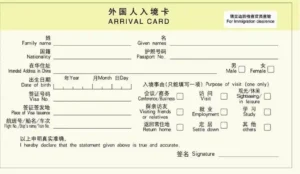
3. Purpose: This serves as the visa’s unique identification number. You will need to provide this number—rather than your passport number—when filling out an arrival card (if applicable), registering at a hotel, or filing a police report.
C. Remarks
1. Content: This section contains additional restrictions or explanatory notes.
- For example: “Holder must enter China before…” (Less common; typically, the “Enter Before” date takes precedence).
- For work or study visas, it often states: “Must apply for residence permit within 30 days of entry.” This remark carries legal force and must be strictly adhered to.
CRITICAL CHECKLIST: Upon Receiving Your Visa
Upon receiving your visa, please perform the following checks immediately; any errors could result in deportation:
1. Name Spelling Check: Does every single letter match exactly with your passport?
2. Passport Number Verification: Does the number match the specific passport you currently hold? (If you have recently renewed your passport, this visa is invalid.)
3. Date and Duration Check:
- Does the “Enter Before” date cover the entire duration of my itinerary?
- Is the “Duration of Each Stay” sufficient to complete my trip? (It is recommended to allow for a buffer of 2–3 extra days to account for potential flight delays.)
4. Entry Frequency Confirmation: Does my itinerary involve departing mainland China (e.g., traveling to Japan, South Korea, Hong Kong, Macau, or Taiwan)? If so, do I hold a double-entry (02) or multiple-entry (M) visa?
5. Visa Category Verification: Does the visa category (L, M, Z, etc.) align with my actual purpose of visit?
6. Remarks Review: Are there any mandatory requirements listed, such as “Must apply for residence permit”?
Common Misunderstandings
1. Myth 1: “My visa is valid until December 31st, with a permitted stay of 30 days. Does this mean I can remain in China until January 30th of the following year?”
- The Reality: Not necessarily. The crucial condition is that you must enter the country *before* December 31st. If you enter on December 30th, you can stay until approximately January 28th (covering the 30 days). However, if you didn’t arrive until January 1st, your visa will have already expired, and you will be denied entry. The only specific scenario where you could stay until January 30th is if you enter—and successfully clear customs—on December 31st itself, before 24:00 (midnight). In this specific case, the 30-day permitted stay is calculated starting from the day *after* entry—meaning January 1st counts as Day 1—allowing you to remain in the country until 23:59 on January 30th.
2. Myth 2: “I took a trip to Macau; can I still return to Guangdong using my single-entry visa?”
- The Reality: No. Although Macau is Chinese territory, it is treated as a “foreign destination” for the purposes of immigration control. Once you leave the Chinese mainland to travel to Macau, your single-entry visa is considered utilized and becomes invalid. You would need a double-entry visa or be required to apply for a new visa to re-enter the mainland.
3. Myth 3: “My permitted stay has expired; can I simply go to the airport, pay a fine, and then leave?”
- The Reality: Absolutely not. Overstaying your visa illegally will negatively impact your ability to apply for visas to *any* country for decades to come. You must ensure you depart the country before your permitted stay expires, or visit the Public Security Bureau in advance to apply for an extension.
A visa is not merely a piece of paper; it serves as your legal identification in a foreign land. Taking just five minutes to carefully review every field mentioned above can spare you the nightmare of being detained, fined, or even deported at the airport.