Home > Posts > F VISA (VISITOR VISA)

F VISA (VISITOR VISA)

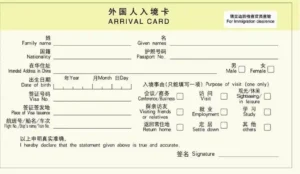
The F visa (visitor visa) is one of the most frequently applied-for visa types for foreign experts, scholars, business travelers, or cultural exchange groups.

Although there is now a convenient policy of “no fingerprinting,” the core of the F visa lies in the verification of the “invitation letter.”

Some visiting scholars holding Chinese F visa have just landed at the airport.

Table of Contents

number-1

What exactly is an F visa?

          The F visa, short for “Visit Visa,” is primarily issued to foreign citizens traveling to China for non-commercial, non-profit exchange activities. This is also the area where many foreign experts, scholars, and business people are most likely to “fall into a trap” because it lies between tourism (L) and work (Z), and the boundary is relatively blurred. However, the Chinese government’s positioning of the F visa is very clear:

Its core keywords are “non-commercial” and “exchange“.

          According to the official definition, the F visa is your preferred option if you are going to China for the following activities:

  • Academic Research: Attending academic conferences, conducting joint research, and visiting laboratories.
  • Cultural Exchange: Performing arts groups, participating in cultural exchange year activities, attending sporting events (non-professional competitions), and giving unpaid lectures.
  • Business Visits: Business negotiations (non-direct trade), market research, and technical exchanges (Note: If it involves signing contracts or sales, an M visa is generally recommended).
  • Short-Term Training: Non-academic short-term technical training or lectures.

Key Features

1. Purpose – Non-commercial exchange, research, cultural/academic activities

2. Validity – 3-6 months for the first/second entry

3. Duration of Stay – Usually a maximum of 30 days per entry (extendable upon invitation)

4. Number of Entries

    • Single Entry: This is the most common.
    • Multiple Entry: Often due to a high-level inviting organization (e.g., multinational headquarters, national-level unit), which may be approved for 6 months or 1 year with multiple entries, each stay ranging from 30-90 days.
number-2

Core material: Invitation letter

          This is the soul of the F visa. Without a valid invitation letter, the application will almost certainly be rejected.

          According to the requirements of Chinese embassies and consulates abroad, the invitation letter must be issued by an inviting organization (such as a university, research institute, or company) within China and must include the following eight core elements:

  1. Invitee Information: Full name, gender, date of birth, passport number.
  2. Purpose of Visit: Must be clearly stated (e.g., “For academic exchange in the field of artificial intelligence”), not just “Visit”.
  3. Itinerary: Expected arrival and departure dates from China.
  4. Visit Locations: Chinese cities to be visited (e.g., Beijing, Shanghai).
  5. Expenses: Who will pay? (e.g., the inviting party will cover accommodation and meals, and the invitee’s institution will cover international travel expenses).
  6. Inviting Organization Information: Full name, address, and contact number of the organization.
  7. Signature of Inviting Organization: Name and position of the signatory.
  8. Official Seal: The official seal of the inviting organization must be affixed. Documents without an official seal are invalid.

Important: In recent years, Chinese border control and embassies and consulates have been very strict in verifying the authenticity of invitation letters. If the itinerary on the invitation letter does not match your actual PSB Registration after entering the country, you may be blacklisted.

number-3

Application process

  • Online application: Log in to www.visaforchina.cn (this is the only official website; other commercial websites are intermediaries).
  • Schedule an appointment for submission: Select “Manila Visa Application Service Center”.
  • In-person submission: Bring the printed application form, passport, photo, original invitation letter, and other materials to the center.
  • Regarding agency processing: F visas allow agency processing. You will need to prepare an “Agent’s Statement,” which can be downloaded and printed from the Visa for China system and signed by the applicant.
  • Fingerprint collection: Unless you meet the exemption criteria (such as being under 14 years old, over 70 years old, or under specific visa waiver policies), you usually need to go in person to have your fingerprints taken. Note: F visas usually do not enjoy the “short-term fingerprint exemption” policy because it is based on a specific invitation, and the consulate often needs to verify identity.

Do not use intermediaries: Never ask an "intermediary company" to issue an invitation letter. If it is found to be a fake invitation, F visa holders may be deported and blacklisted.

“An F visa is specifically for "officially funded business trips or academic exchanges," and it primarily relies on an invitation letter from a legitimate employer in China."

You may also like

This is the outside of MIT. Its professors and tenured professors can apply for an R visa to enter China.

R VISA (TALENT VISA)

This is currently the most valuable visa type in China, often referred to as the “prelude to the Chinese version of the green card.”

It is specifically designed for foreign talents with top abilities in fields such as science, economics, and education.

Read More »
The wooden block with the words "SCAM," suggesting a visa scam involving fake visa in Chinese visa applications.

VISA SCAMS PEOPLE ENCOUNTER​

With the acceleration of digitalization, phishing websites and fake agents have become more rampant and difficult to distinguish. For applicants for Chinese visas, Chinese embassies and consulates abroad typically do not directly handle the receipt and payment of ordinary visa applications.They authorize specific visa application service centers (such as VFS Global, BLS, etc.).This is the most crucial point in identifying scams.

Read More »
A woman stood in front of the immigration office in the airport, holding a travel guide, preparing for China travel.

AIRPORT GUIDE AND TIPS

Airports are undergoing a digital transformation, with self-service check-in and e-passport gates becoming increasingly common. However, in the Philippines, human assistance remains crucial, especially in the event of technical malfunctions or complex situations. Stay flexible and allow for buffer time to ensure your documents are readily available. A little preparation can bring you composure and confidence throughout the journey.

Read More »
A Chinese visa applicant's materials were marked with "rejected" in red, and he wanted to know the visa rejected reasons.

VISA GOT REJECTED BUT COMPLETE DOCUMENTS

We understand how frustrating it can be to receive a visa rejection when you believe your documents are complete.

Unfortunately, having all the required documents doesn’t guarantee approval 

Visa officers assess much more than just paperwork completeness.

Read More »
Foreigner's visitng one of the famous tourist spot in china

CHINA TRAVEL TIPS FOR FOREIGNERS

If you’re visiting or staying in China as a foreign national, your trip will run much smoother if you focus on three essentials:

digital preparation, legal compliance, and cultural etiquette.

As of early 2026, China has significantly expanded its visa-free entry program, making travel easier for citizens of many countries.

Read More »
Scroll to Top

To reset your password, please enter your email address or username below.

Announcement

          The online visa application management system on the account terminal is currently undergoing updates. Business is temporarily being conducted offline. We will reopen the online application system once the system is updated and complete.

          We sincerely apologize for any inconvenience caused.

Published: March 29, 2026