Home > Posts > AIRPORT GUIDE AND TIPS

AIRPORT GUIDE AND TIPS

Airports are undergoing a digital transformation, with self-service check-in and e-passport gates becoming increasingly common.

Nevertheless, in the Philippines, human assistance remains crucial, particularly in the event of technical malfunctions or complex situations.

Stay flexible and allow for buffer time to ensure your documents are readily available.

A little preparation can bring you composure and confidence throughout the journey.

A woman stood in front of the immigration office in the airport, holding a travel guide, preparing for China travel.

Table of Contents

number-1

Check Before You Leave Home

           Before leaving home, you must complete the following three strategic checks; neglecting any one of them could result in you being offloaded at the airport.

1. Book Strategically

  • Confirm Destination: Double-check the airport code on your ticket. Many cities in China use this code (e.g., Shanghai uses PVG and SHA, Beijing uses PEK and PKX). Make sure you have the correct city and terminal.
  • Transit Risks: If you have a connecting flight (e.g., in Seoul or Bangkok), confirm whether a transit visa is required, whether your luggage is checked through, and whether you need to retrieve your luggage again.
  • Time Allowance: For international flights, it is recommended to arrive at the airport (NAIA T1/T2/T3 or Clark/Cebu) 3-4 hours before departure. This is because traffic in the Philippines is unpredictable, especially during rush hour, so be sure to allow ample travel time. Furthermore, even excluding long queues, it will take at least an hour to get from the entrance to the boarding gate.

2. Pack Smartly

  • Weight Restrictions: Strictly adhere to airline baggage allowances (typically 20-23kg for checked baggage and 7kg for carry-on in economy class). Excess baggage fees are very expensive and must be paid at the counter.
  • Prohibited Items: Lighters, large-volume liquids (>100ml), and power banks are strictly prohibited (must be carried on board, not checked baggage).
  • Special Note from Chinese Customs: Fresh fruits, meat products, and seeds are strictly prohibited from entering China. While Philippine tropical fruits are delicious, they may be confiscated and subject to fines by Chinese customs.

3. The Document TrinityDon’t rely solely on your phone; instead, printing backups is one of the safest precautions. This is because the airport signal isn’t always stable, and when there are a lot of people connecting, some online content might fail to load, causing unnecessary inconvenience.

          To ensure you are prepared:

  1. Digitally: Take screenshots of all the files and save them on your phone.
  2. Physically: Print out a paper copy and place it in the outermost layer of your bag.

          Therefore, the following documents are best kept in a place that is easy to access.

  • Passport: Must be valid for more than 6 months.
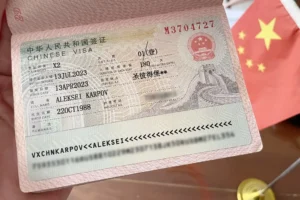
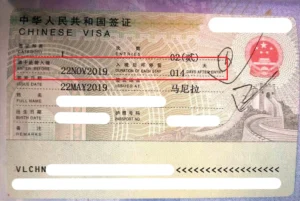
  • Visa: Hold a valid Chinese visa (sticker visa; China currently does not offer e-visas). If transiting without a visa (144-hour policy), you will need to prepare a flight ticket to a third country.
  • Itinerary: Print out your round-trip ticket confirmation. This is the strongest evidence that you will return to the Philippines.
  • Proof of accommodation: Print out the hotel reservation or the address information of the person inviting you to come to  China.
number-2

At the Airport: Step-by-Step

A man stood in front of the immigration office in the airport, holding a travel guide, preparing for China travel.

      The procedures at major international airports in the Philippines (such as NAIA in Manila) are as follows:

          STEP 1:Entry & Initial Check

          At the entrance, security personnel may ask to see your passport and same-day flight ticket information (a mobile electronic copy is acceptable).

          Only passengers with same-day departure tickets are allowed to enter the departure hall.

          STEP 2: Check-in Counter

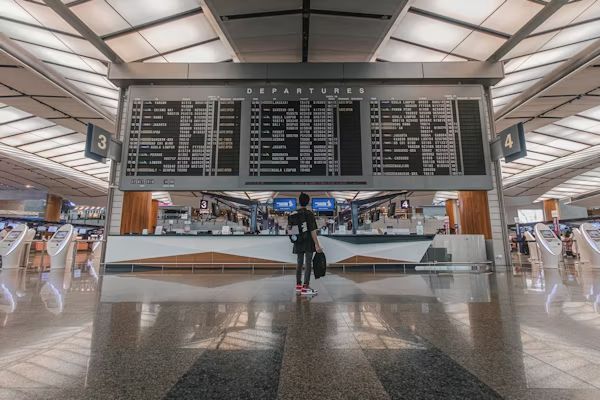
  • Find the counter: Look at the Departures Screen and find the corresponding airline counter based on your flight number.
  • Queue Preparation: Prepare your passport and visa pages.

                    1. Philippine Travel Tax: If this tax (approximately PHP 1,620) was not included in your ticket, you will need to pay it at a designated “Travel Tax Counter” or directly at some airline counters.

                    2. Keep your receipt: Immigration officers may need to see it.

                    3. Baggage: Ensure your luggage is within weight limits. Remove lithium batteries/power banks and carry them with you.

  • Get your boarding pass: After receiving your boarding pass, carefully check your name, flight number, gate, and boarding time.

          STEP 3: Immigration / Bureau of Immigration

          This is the most tense point of departure from the Philippines. Officials have the authority to prevent any traveler they deem a risk of “illegal employment” or “human trafficking” from leaving the country.

  • Queuing: Holders of foreign passports should use the “Foreign Passport” lane, and holders of Filipino passports should use the “Filipino Passport” lane.
  • Document Submission: Submit your passport and boarding pass.
  • Interview Q&A:

                    1. Attitude: Stand straight, smile, and make eye contact. Don’t be nervous; nervousness can be perceived as insecurity.

                    2. Principles: Answer questions one at a time. Don’t offer information not asked for, and don’t launch into lengthy explanations.

                    3. Frequently Asked Questions:

“Where are you going?” -> “Shanghai, China.”

“What is the purpose of your travel?” -> “Tourism” / “Business Meeting” / “Visiting Family”.

“How long will you stay?” -> “5 days.”

“Who are you traveling with?” / “Who is sponsoring you?”

……….

                   4. Supporting documents: If the officer asks further questions, immediately present the prepared supporting documents (see “Immigration Survival Kit” below).

          STEP 4: Security Check

          After passing through immigration, proceed to the security checkpoint. Remove your shoes and belt, and take out your laptop, tablet, umbrella, and all metal items, placing them in the basket. Ensure your carry-on liquids do not exceed 100ml.

          After passing through, organize your belongings and retrieve your passport and boarding pass.

          STEP 5: Waiting & Boarding

  • Find your gate: Follow the gate number on your boarding pass.
  • Secondary confirmation: Airport screens may temporarily change your gate number; check the screen every 15 minutes.
  • Boarding: After hearing the announcement, queue to show your boarding pass and passport.
  • Seats: Find your seat, fasten your seatbelt, and prepare for takeoff.

number-3

Immigration Survival Kit

          Many first-time travelers are “offloaded” due to excessive nervousness. However, it is important to remember that this is often avoidable. In fact, as long as one is honest and well-prepared, the vast majority of people can pass through customs smoothly.

Do's

1.Neat Documentation: Use transparent document folders to arrange your passport, visa, round-trip tickets, hotel bookings, and invitation letter in order. This ensures the documents are easily visible to officials.

2.Affidavit of Support (AOS): If the trip is sponsored by someone else, a notarized AOS document is required, along with a copy of the sponsor's ID and proof of funds.

3.Invitation Letter: For family visits or business trips, a formal invitation letter from the Chinese side is mandatory (including the inviter's information, explanation of the relationship, itinerary, and guarantee obligations).

4.Practice Questions: Practice answering the three core questions (Where are you going? What are you going for? How long?) in front of a mirror at home. Speak loudly and confidently.

Don'ts

1.Don't be frivolous or overly casual: Maintain respect and professionalism.


2.Don't proactively mention "working": Unless you have a valid work visa, never say you're going to "look for work" or "help out," as this will result in immediate deportation.


3.Don't show impatience: Even if officials ask repeatedly, answer patiently; they are simply doing their job, so cooperate.


4.Honesty is paramount: Never lie. If caught lying, you will be blacklisted immediately.

5.Don't attempt bribery: This is a serious crime.

number-4

After arriving in China

  • Health Declaration: Although pandemic policies have been relaxed, it is recommended to check in advance whether Chinese customs requires a Health Declaration Card (usually available through the WeChat mini-program “Customs Passenger Fingertip Service”).
  • Arrival Card: Some ports of entry may require an arrival card; simply fill it out truthfully.
  • Internet Preparation: Google, Facebook, WhatsApp, etc., are not directly accessible in China. Please purchase a roaming package or prepare a VPN solution in advance (provided it complies with regulations).

"Catch flights, not feelings. The best stories start from your passport."


Every takeoff is a brand new adventure. Explore the world and enjoy yourself. Forget your anxieties and face everything bravely.

  • Don’t hesitate to ask: Seek help from airport staff or travel agency experts.
  • Believe in yourself: You are fully prepared.

Wishing you a smooth journey from the Philippines to China!

You may also like

z visa (work visa) , issued in year 2023 ,and also its just single entry

Z VISA (WORK VISA)

The Z visa is China’s official Work Visa — the mandatory entry visa for foreign nationals who plan to work legally in China.

If you have a job offer from a Chinese employer and plan to work in China for more than 90 days,

You need a Z visa to enter the country legally.

Read More »
china's exit and entry administration bureau that handles residence permits for foreign nationals

D VISA (PERMANENT RESIDENCE VISA)

The D Visa is China’s official Permanent Residence Entry Visa. It is NOT a tourist, work, or student visa.

It is the special entry document that allows foreign nationals who have already been approved for China’s “Green Card.”

(Foreign Permanent Resident ID Card) to enter China and begin their permanent residence journey

Read More »
A Chinese visa application paper gets rejected, they need advices

VISA REJECTION: CAUSES, CONSEQUENCES, AND STRATEGIC PREVENTION

Many applicants have their visas refused, not because they are “unqualified,” but because of missing documents, contradictory information, or providing false materials.

This pressure is real, but excessive anxiety (overthinking) often leads applicants to prepare incorrect documents or even perform poorly in the interview due to nervousness.

The core logic of visa officers (VOs) is simple: “presumption of guilt.”

That is, they assume you have an intention to immigrate unless you can provide irrefutable evidence that you will return to your home country on time.

Below are six core reasons for visa refusal and an in-depth analysis:

Read More »
A visa type in a Chinese visa application has many kinds.

CORRECT VISA THAT APPLIES ON YOUR SITUATION

 There is no single visa that applies to every situation. Visa requirements are highly specific and depend on multiple factors.

The “correct visa” is determined by the intersection of who you are (Nationality ) , where you’re going (Destination Rules ) ,and why you’re going (Purpose Of Travel ).

There is no universal visa – careful research and proper knowledge are essential for compliance and successful entry.

Read More »
working, but didn't have a certificate of employment to get a Chinese visa application

WORKING BUT DON’T HAVE CERTIFICATE OF EMPLOYMENT

In the Philippines, many companies (especially family businesses, startups, or those in the informal sector)do indeed lack standard HR procedures for issuing a Certificate of Employment (COE).

For Chinese visa applications, the key is to use “government filing documents” and “fund flow records” instead of “company letters.”The visa officer isn’t looking for a piece of paper; they’re looking for a “stable income stream” and “ties to your home country.”As long as you can prove your money was earned legally and that you have inescapable responsibilities in the Philippines,you can get a visa even without a Certificate of Employment (COE).

Read More »
place in china with many people on it ,symblolizing the population of china and their kind of living

CHINA’S WAY OF LIVING

China’s lifestyle blends ancient traditions with hyper-modern innovation.

Here’s an authentic look at how people live, work, and connect in China today:

Read More »
Scroll to Top

To reset your password, please enter your email address or username below.

Announcement

          The online visa application management system on the account terminal is currently undergoing updates. Business is temporarily being conducted offline. We will reopen the online application system once the system is updated and complete.

          We sincerely apologize for any inconvenience caused.

Published: March 29, 2026