Core concept: Why are there not enough original parts?
Many people mistakenly believe that simply possessing the original documents is sufficient. However, in the international legal system:
“validity of origin” ≠ “global applicability”
- Limitations: A birth certificate issued in Manila, Philippines, without authentication, may be seen as nothing more than an “unverifiable piece of paper” by government agencies in China, the United States, or European countries.
- Trust Crisis: Foreign governments cannot directly verify the authenticity of a Philippine official’s signature. To prevent fraud, they require an internationally recognized verification mechanism.
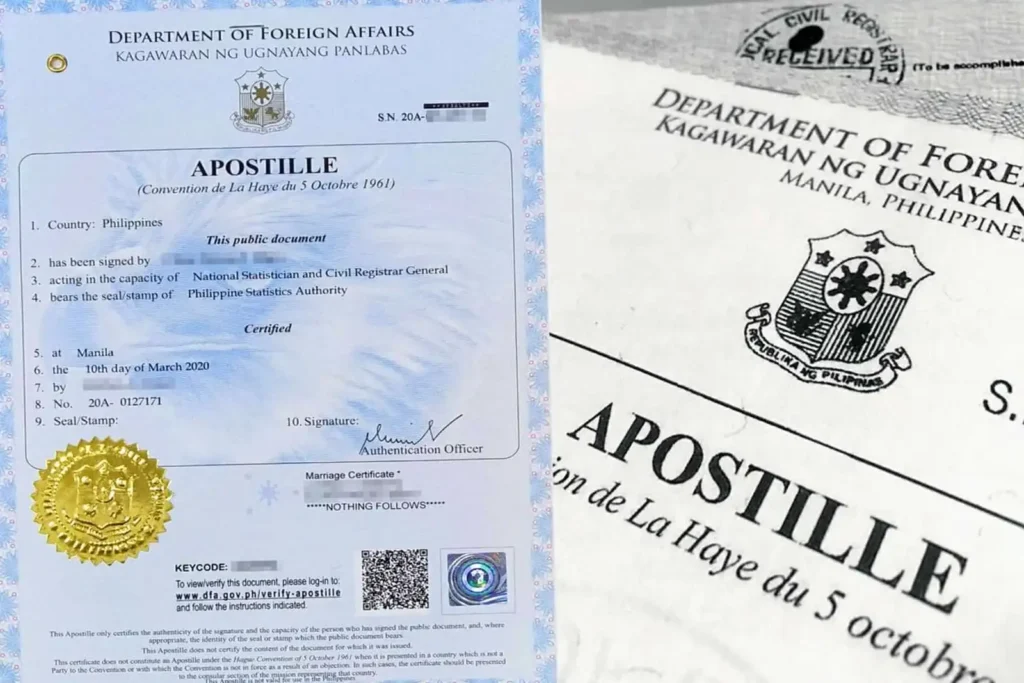
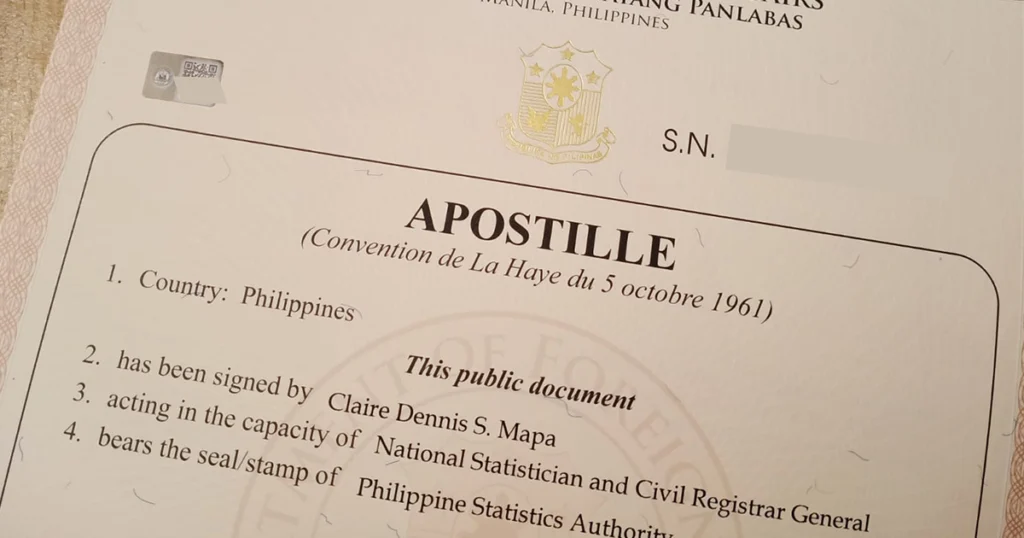
- Solution: Apostille. It doesn’t prove the authenticity of a document’s contents (for example, it doesn’t guarantee you were actually born on that day), but rather that the official who issued the document had the legitimate authority to sign and seal it.
This is an international authentication method provided by the 1961 Hague Convention, used to authenticate documents used abroad. Its function is to prove the authenticity of the document, and it is generally recognized by member states that have acceded to the Hague Convention; currently, there are over 120 member states.
Core objective: To eliminate cumbersome diplomatic authentication procedures for cross-border document transfers, enabling a Philippine document to gain direct legal effect in other Hague Convention member states.
Which documents require Hague Apostille certification?
If you plan to use Philippine-issued public documents overseas, the following three categories are the most frequent needs:
1. Personal Documents: It applies to overseas marriage, immigration applications, children’s school enrollment, inheritance, and processing of visas for foreign spouses.
- Birth Certificate (PSA Birth Certificate)
- Marriage Certificate (PSA Marriage Certificate)
- Certificate of No Marriage Record(CENOMAR)
- Death Certificate
- Divorce Decrees (requires court documents)
- Adoption Papers
2. Educational Records: Suitable for overseas job seeking, applying to foreign universities, professional qualification certification, and work visas.
- University degree certificate (Diplomas)
- Transcripts of Records
- High school graduation certificate
- Note: Educational documents usually need to be certified by the Philippine Department of Education (DepEd) or the Commission on Higher Education (CHED) before they can be processed at the Department of Foreign Affairs.
3. Legal & Commercial Documents: It applies to overseas litigation, power of attorney, company registration, and real estate transactions.
- Power of Attorney (Special/General Power of Attorney)
- Affidavits
- Court Orders
- SEC Registration, Articles of Incorporation
- BIR Documents
- NBI Clearance
The Process in the Philippines
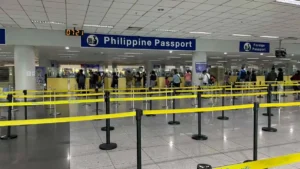
In the Philippines, the issuing authority for Hague Apostille certification is the Department of Foreign Affairs (DFA).
STEP 1:Get the Original Documents
Make sure you have the original or a certified copy issued by the relevant authority.
- Personal documents: Must be the latest version certificate with a security feature obtained from the PSA (Philippine Statistics Authority).
- School documents: Must first be issued by the school registrar and then verified by CHED or DepEd.
- Court/Notary documents: Must be verified by the RTC (Regional Trial Court) or the Supreme Court.
STEP 2:Submit it to DFA
You can choose to submit it in person or through an authorized representative.
- Locations: DFA ASEANA (Pasay), DFA NCR East/West/North/South, or DFA Regional Offices (such as Cebu, Davao). (Generally, local DFA offices can only process passport-related documents, but are not authorized to process notarized documents.)
- Original documents (no photocopy required, will be verified on-site).
- Applicant’s ID card (original and photocopy).
- If handled by a representative, a power of attorney and the representative’s ID card are required.
STEP 3: Payment & Processing
- Fees: Please refer to the DFA notary appointment link for fee requirements details.
- Collection: Present the receipt to collect the Apostille certificate, which features a silver anti-counterfeiting label and a QR code.
Why is it a "Necessary Trouble"?
As you can see, this process is indeed a headache:
- Cumbersome: Requires visits to multiple institutions (school -> Ministry of Education -> Ministry of Foreign Affairs).
- Time-consuming: Queuing, appointments, and waiting for processing can take several weeks.
- Cost: Although official fees are low, the total cost is not inexpensive when transportation, agency fees, and time are factored in.
However, its value is irreplaceable:
- The Ultimate Gatekeeper: Without it, your documents are “invalid” in the eyes of overseas officials. With it, you get a “VIP pass.”
- Reject “Secondary Authentication”: Before the Hague Convention, you needed double stamping—”Ministry of Foreign Affairs authentication + destination country embassy authentication”—which took months. Apostille does it all in one step.
- Turn “Possibility” into “Confirmation”: It transforms a foreign official’s perception
“This might be fake. I need to investigate further.” ==> “This is legitimate, we can proceed.”
The Philippines officially acceded to the Hague Convention in 2019. Before this, exporting Philippine documents required a complex process involving both Red Ribbon authentication and embassy legalization. Now, an Apostille has completely replaced Red Ribbon authentication as the sole international standard.
Precautions
1. Not all countries are eligible: Apostille is only applicable to member states of the Hague Convention (such as the United States, the United Kingdom, Japan, South Korea, Australia, and most EU countries).
If the document is intended for use in mainland China (note: China acceded to the Convention in November 2023, and it is now applicable), Vietnam, or some non-member states, traditional consular legalization may still be required. Please consult the embassy of the destination country for specific details.
2.It’s not responsible for the accuracy of the information: The DFA only verifies the authenticity of signatures and seals. If your name is misspelled on your birth certificate, obtaining an Apostille will also be incorrect.
Please ensure you carefully verify the information in the first step (PSA/school stage).
3. Validity period: Apostille certificates typically do not have a fixed expiration date. As long as the document content remains relevant (e.g., a criminal record check usually has only a 6-month validity period), the certification remains valid. However, the specific acceptance level is determined by the authorities in the destination country.
Without this “passport,” your documents can only travel within your own country;
With it, your documents can travel freely on the world stage.
Although the application process is full of waiting and tedious details, when you successfully buy a house, get married, or start a job overseas with it, you’ll understand that it was all worth it.